Guía y Práctica
Mastering Spanish Connectors
and the Subjunctive Mood
A comprehensive guide for intermediate students

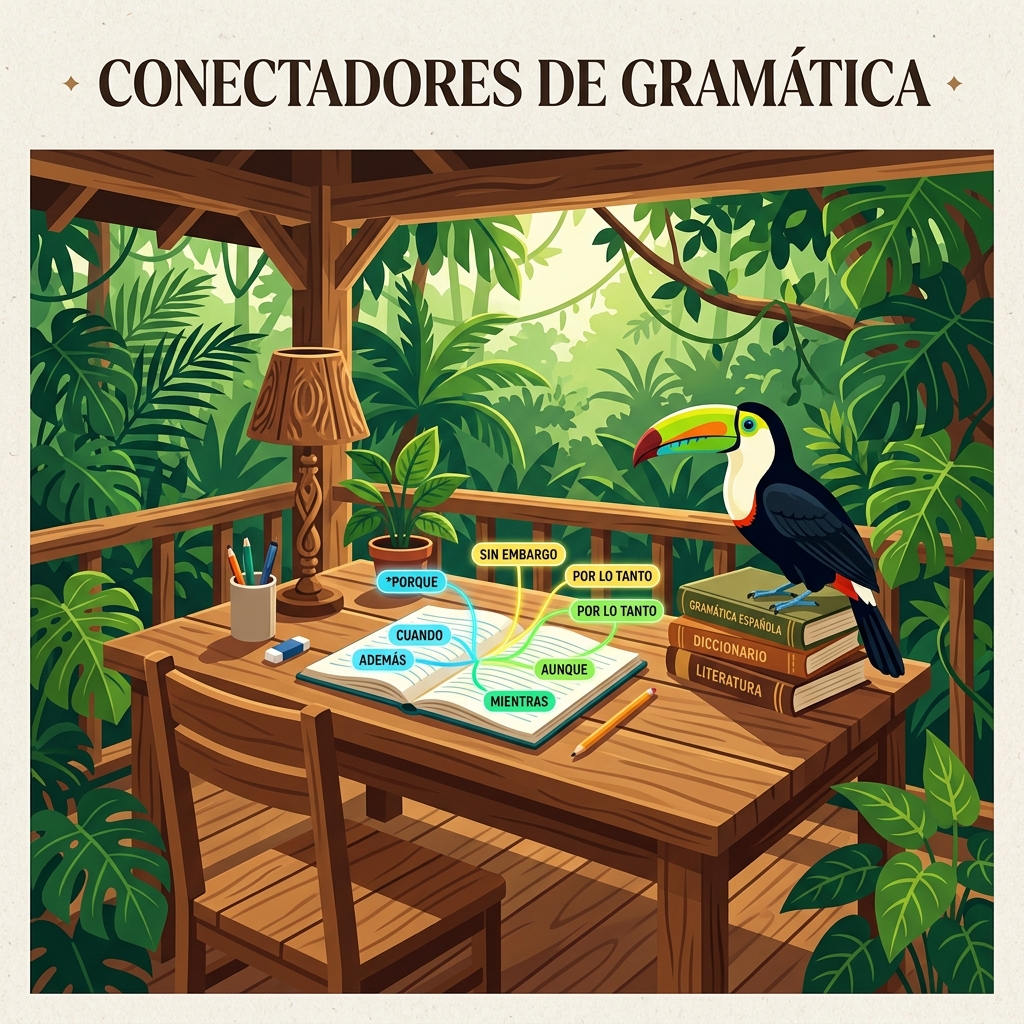
The subjunctive is a mood, not a tense. While the indicative mood states objective facts (e.g., Él estudia mucho), the subjunctive expresses personal attitudes, desires, doubts, emotions, and conditions.
Certain conjunctions (connectors) will always require the subjunctive mood after them, regardless of whether you are talking about the present, the future, or general habits.
Here are the most important ones:
Some connectors, like cuando (when) and tan pronto como / en cuanto (as soon as), change depending on the context of the sentence.
If you are talking about a specific event that will happen in the future, use the subjunctive.
If you have clues in the sentence indicating that the action happens always, usually, or every day, you use the indicative.
Students often struggle to choose between the Subjunctive and Indicative/Coordinate structures for future events. It depends on whether you are describing a fixed, controlled plan or a dependent future condition/milestone where you don't have full control.
| Context | Subjunctive (Dependent / Conditional) | Indicative / Coordinate (Factual / Fixed Plan) | Key Concept (Why?) |
|---|---|---|---|
| Age & Milestones | Cuando ella tenga dos años, tendrá su silla. (When she turns two...) |
Ella va a tener dos años y va a tener su silla. (Factual planned future) |
Avoid double futures: Do not say "vaya a tener". If it is a coordinate fact, use indicative. If it is a time clause, use simple subjunctive. |
| Scheduled Visits | Cuando yo vaya a tu casa, te llevaré la ropa. (Whenever I go to your house...) |
Voy a ir a tu casa a las 5 y te llevaré la ropa. (Fixed time appointment) |
Lack of Control: Subjunctive implies "whenever it happens". Indicative shows a certain, fixed coordinate in time (e.g. 5:00). |
| Time Limits (Hasta que vs. Período Fijo) | Voy a trabajar en esta empresa hasta que tenga 60 años. (Until I turn 60 years old — Subjunctive for an unreached future milestone) |
Voy a trabajar en esta empresa durante 5 años. (Factual duration period — Indicative) |
Milestone vs. Duration Period: "Hasta que" + Subjunctive specifies a future endpoint/condition that hasn't occurred yet. "Durante [período]" states a fixed duration fact using Indicative. |
Instrucciones: Lee el siguiente texto sobre los planes de Miguel y responde a las preguntas en español.
Instrucciones: Selecciona el conector lógico correcto para cada oración según el contexto.
(Opciones: para que / sin que / tan pronto como / a pesar de que / con tal de que)
Instrucciones: Imagina que tienes un nuevo compañero de apartamento y quieres establecer algunas reglas claras para vivir juntos en paz. Escribe 5 reglas usando el vocabulario de la casa y diferentes conectores o "triggers" del subjuntivo. ¡No repitas los conectores!
Ejemplo: Es importante que tú laves los platos después de cenar para que la cocina siempre esté limpia.
Instrucciones: Traduce las siguientes frases al español prestando atención a si debes usar el Subjuntivo (futuro) o el Indicativo (rutina).