THE ULTIMATE PAST TENSE GUIDE
Understand it. Form it. Use it.
A Comprehensive Guide to the 3 Spanish Pasts.

A Comprehensive Guide to the 3 Spanish Pasts.
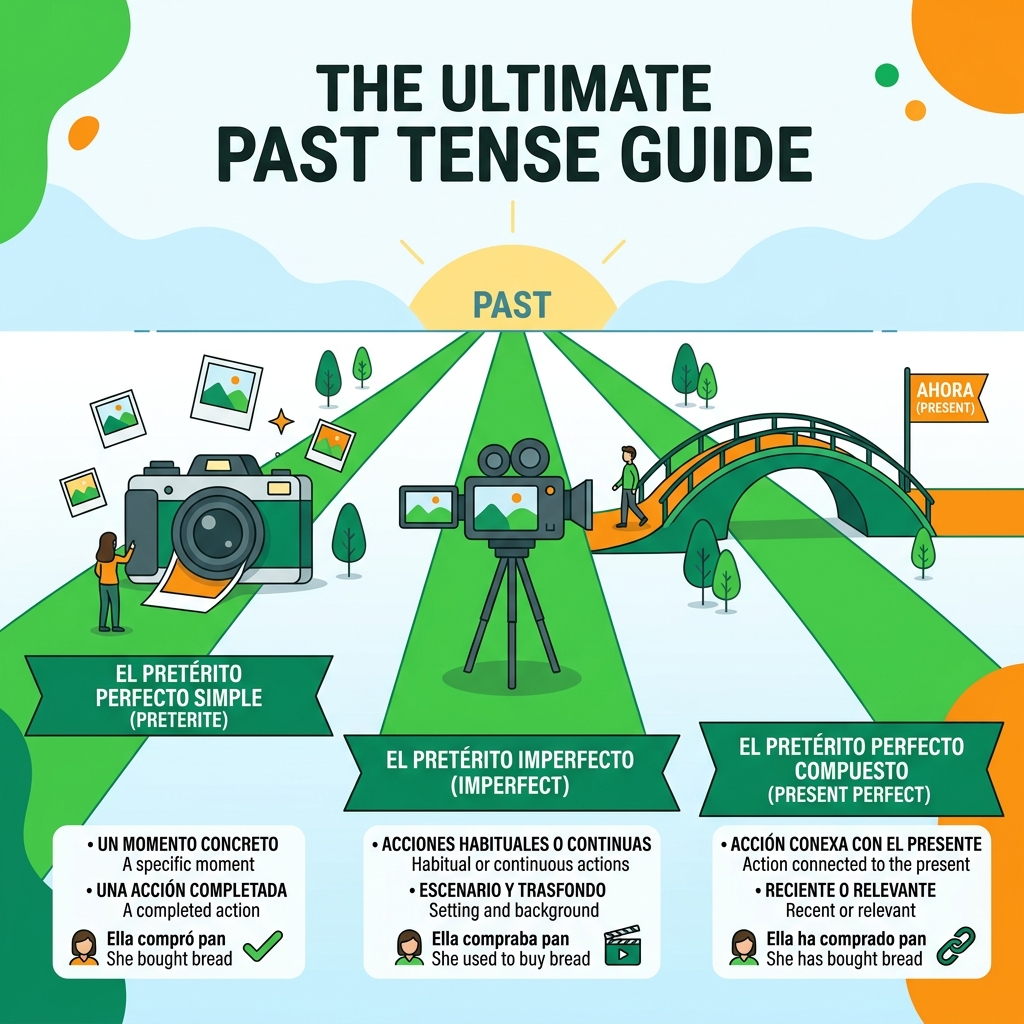
In Spanish, talking about the past is all about perspective. It’s not just about what happened, but how you view the action. Are you watching a video? Looking at a photograph? Or talking about something that is still connected to today?
Think of the Imperfect as a video or background music. It describes ongoing situations, habitual actions (“used to”), or how things were in the past, with no definite ending.
Think of the Preterite as a snapshot. It tells you exactly when something happened and focuses on completed actions with a clear beginning and end.
This tense works exactly like the English Present Perfect. It is used when the time period is still open and hasn't finished yet.
| Tip Name | Explanation | Example |
|---|---|---|
| The Interruption Rule | The Imperfect is the ongoing background action, and the Preterite is the sudden event that interrupts it. | Yo leía un libro cuando sonó el teléfono. |
| Never Split Haber | In the Present Perfect, "No" always goes BEFORE haber. | Yo no he comido. |
Time markers are your best clues! Classify the following time markers into the correct tense. Some tenses will have more than others.
Decide if the time frame is OPEN or CLOSED. Then, conjugate the verb correctly. Use Pretérito Perfecto for open frames, and Pretérito Indefinido for closed frames.
One verb is the ongoing background action (Imperfect) and the other is the interrupting sudden action (Preterite). Conjugate them correctly.
Read the diary entry. Use context clues to decide whether to use Imperfect, Preterite, or Present Perfect.
Book a free trial class with Camilo
and start your journey today.